The journey of a turfgrass variety from an experimental trial plot to large-scale commercial production is a rigorous, multi-year process grounded in science, research and development, and quality assurance. This process ensures that only turfgrasses with proven performance and suitability are released to the Australian market. Understanding this process highlights the importance of research driven selection, local validation, and certification systems in delivering turf that is fit for the Australian environment
What happens in a turf trial plot?
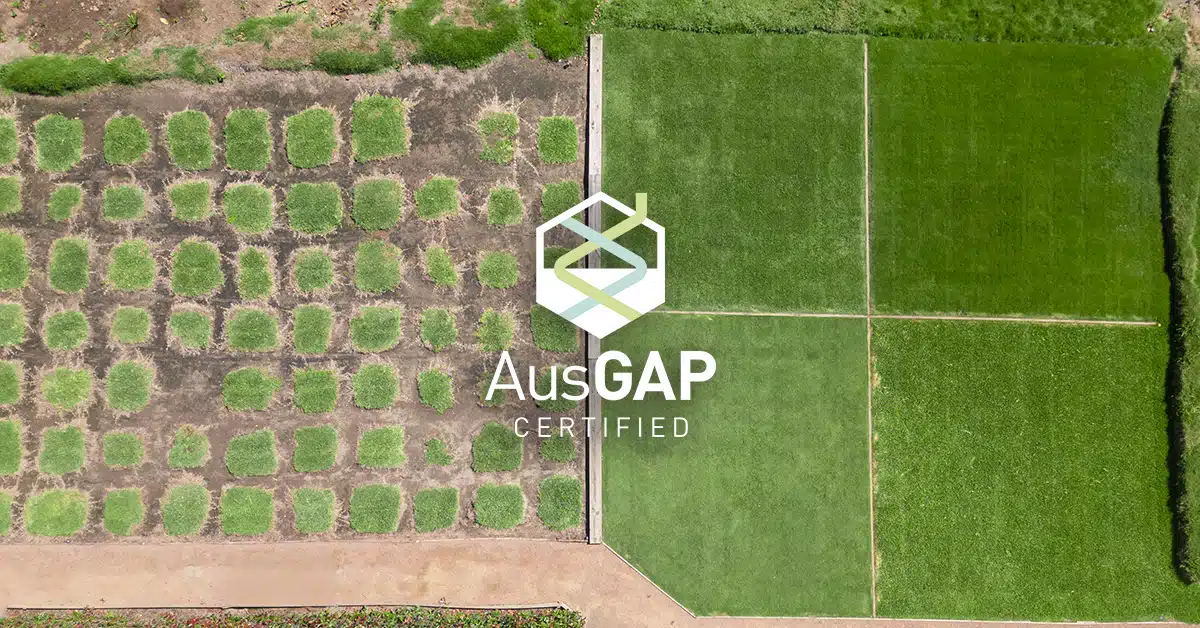
Trial plots represent the earliest stages of turfgrass evaluation and are typically established by breeders, universities, or research organisations. These plots are designed to assess cultivars under controlled yet realistic conditions, allowing researchers to compare performance traits across multiple environments.
At this stage, turfgrasses are assessed for establishment rate, growth habit, density, colour retention, wear tolerance, drought response, pest and disease resistance, and overall uniformity. Turfgrass trials often run for several years to capture seasonal variability and identify any genetic instability, mutation, or undesirable traits that may emerge over time.
Why are multiple trial locations important?
Performance in a single environment does not guarantee success across broader climatic regions. This is especially relevant in Australia, where temperature extremes, rainfall patterns, soil types, and management practices vary significantly.
Trials across multiple locations enables researchers to evaluate how a turfgrass responds under different environmental pressures, identify regional strengths and limitations, and validate performance under management practices. Locally generated data after importing a turfgrass from overseas is essential for determining whether a turfgrass is suitable for widespread commercial release, rather than relying solely on overseas or controlled-environment data.
How does a turfgrass cultivar move from research to commercial production?
Once a turfgrass cultivar has demonstrated consistent and reliable performance in trials, it may progress toward commercial production. This transition involves establishing foundation material from the original genetic source, which serves as the basis for all future propagation.
At this stage, maintaining genetic purity becomes critical. Each increase in production area introduces a greater risk of contamination. Careful management is required to ensure that the characteristics observed in trial plots are preserved as the turfgrass is scaled up for commercial supply.
What challenges arise during commercial expansion?
Moving from small research plots to full-scale turf farms introduces a range of challenges not encountered during the trial phase. Larger production areas increase exposure to weed incursions, pest pressure, mechanical contamination during planting, mowing, and harvesting and inconsistencies in management practices.
Without strict oversight, these factors can compromise turf uniformity and genetic purity. Even the best turfgrass varieties can lose their defining traits if production standards are not tightly controlled throughout the entire process.
Why does certification matter in the transition to turf farms?
The AusGAP certification program play a vital role in safeguarding the connection between research outcomes and commercial turf production. Through regular inspections, controlled limits on propagation generations, and rigorous auditing of production practices, AusGAP ensures that turfgrass maintains its identity from foundation material through to harvest.
Independent certification provides confidence to growers, specifiers, and end users that the turf being supplied is true to type, genetically pure, and produced in accordance with internationally renowned standards. This assurance is particularly important for turfgrasses that have undergone extensive research and development before release. For example, TifTuf spent 30 years in research and development before being released to market, making it is one of the most researched grasses on the market.
The pathway from trial plot to turf farm is defined by scientific evaluation, disciplined production practices, and accountability. Each stage of the process contributes to ensuring that turfgrasses perform as expected when installed in landscapes, sports fields, and public spaces. When research-backed turfgrasses are supported by industry leading production standards and independent certification, the result is a product that delivers consistency, reliability, and performance across Australian conditions.